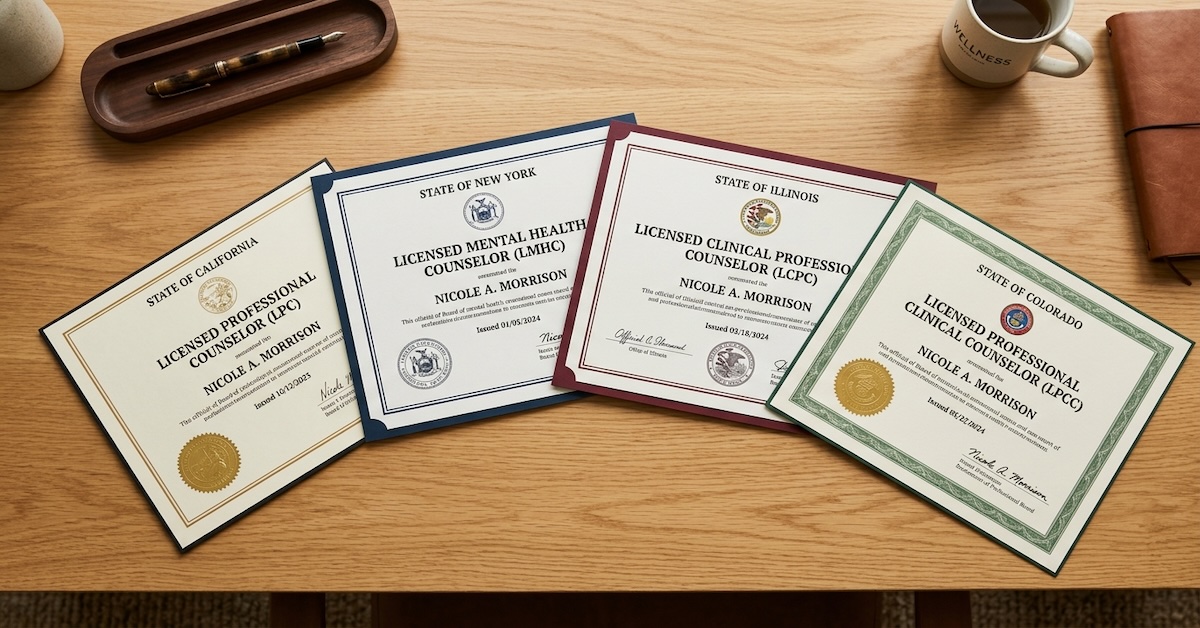
LPC, LMHC, LCPC, LPCC: Why Your Counseling License Has a Different Name in Every State
LPC, LMHC, LCPC, and LPCC often refer to comparable master’s-level professional counseling licenses, but titles, tiers, scope, exams, and endorsement rules vary by state. If you hold an LPC in Texas and seek New York licensure, you apply through New York’s licensure or endorsement process for the LMHC, subject to New York’s education, exam, experience, and endorsement requirements.
You’ve researched counseling programs, looked up licensing requirements, and landed on three different acronyms that all seem to mean the same thing. LPC in one state. LMHC in another. LCPC somewhere else. LPCC in California. Nobody explains this upfront, which creates real confusion for prospective counselors planning a graduate program or career path. This article explains why the names differ, what they have in common, how they vary at the margins, and what it means practically when you move between states.


Why Does the Same License Have Different Names?
Counseling licensure in the United States is governed at the state level. There is no federal counseling license. Each state legislature passed its own counseling licensure law, often at different times, and each chose its own title for the credential. Some states used “Licensed Professional Counselor.” Some used “Licensed Mental Health Counselor.” A few used “Licensed Clinical Professional Counselor” or “Licensed Professional Clinical Counselor.” The underlying requirement structure is similar across all of them, but the names reflect independent legislative decisions made decades apart.
The result is a patchwork of titles that generally reflect comparable professional levels but look different depending on which state’s website you land on. In most cases, this isn’t a signal of meaningfully different training or scope, but state-specific differences in requirements, tiers, and scope do exist. It’s primarily a product of how professional licensing works in a country where states hold primary authority over occupational credentials.
The National Board for Certified Counselors (NBCC), which administers the national counseling exams used by most states, has worked for decades to encourage standardization. Most states now use the same examinations (the NCE or NCMHCE) as part of their licensure process. But the title each state uses for the resulting license remains a state-by-state decision.
What LPC, LMHC, LCPC, and LPCC Have in Common
Despite the different names, these credentials share a common core in most states. The typical credential in this family reflects a master’s-level counselor who has completed a supervised post-degree clinical experience requirement and passed a national licensure examination. That combination is what authorizes independent practice in most states, though specific requirements vary.
The shared requirements across virtually all states in this credential family include:
Graduate education. A master’s degree in counseling or a closely related field, typically 60 semester credit hours. Many states specify counseling-degree content, accreditation, or equivalency standards, and some reference CACREP accreditation directly. Requirements vary substantially by state and should be verified before enrolling in a program. The degree must include supervised clinical practicum and internship hours as part of the program itself.
Post-degree supervised experience. A period of supervised clinical work after graduation, during which the counselor practices under the oversight of a board-approved supervisor. Requirements vary by state regarding total hours, the ratio of individual to group supervision, and the qualifications required of the supervisor.
Licensure examination. Passage of a recognized national exam. The two most commonly required are the National Clinical Mental Health Counseling Examination (NCMHCE) and the National Clinical Mental Health Counseling Examination (NCMHCE), both administered by NBCC. Some states accept both. Others specify one. The exam requirements are established by each state board independently.
Continuing education. Ongoing professional development requirements to maintain the license in active standing typically range from 20 to 40 hours per renewal cycle, depending on the state.
License Names by State
The table below is a general orientation guide showing which title each state is commonly associated with for its independent counseling credential. Because some states use multiple counseling tiers or have changed titles over time, verify the current independent-license title and requirements directly with your state licensing board before making any program or licensing decisions.
| License Title | States | Notes |
|---|---|---|
| LPC (Licensed Professional Counselor) | Alabama, Alaska, Arkansas, Colorado, Connecticut, Delaware, Georgia, Idaho, Iowa, Kansas, Louisiana, Maine, Michigan, Mississippi, Missouri, Montana, Nebraska, Nevada, New Hampshire, New Jersey, New Mexico, North Carolina, North Dakota, Ohio, Oklahoma, Oregon, Pennsylvania, Rhode Island, South Carolina, South Dakota, Tennessee, Texas, Vermont, Virginia, West Virginia, Wisconsin, Wyoming | Most widely used title nationally. Some LPC states also use an associate-level title (e.g., LPC-Associate in Texas) for the pre-licensure supervised phase. |
| LMHC (Licensed Mental Health Counselor) | Florida, Indiana, Massachusetts, New York, Washington | Same scope as LPC in most respects. Massachusetts LMHCs have specific supervised hour requirements. New York LMHC has a distinct two-stage structure. |
| LCPC (Licensed Clinical Professional Counselor) | Idaho, Illinois, Maryland, Montana | Idaho uses both LPC and LCPC as separate tiers. LCPC is the highest clinical license. Illinois uses LCPC as the sole independent counseling title. |
| LPCC (Licensed Professional Clinical Counselor) | California, Kentucky, Minnesota, New Mexico, Ohio | California’s LPCC has state-specific education, experience, exam, and practice requirements set by the California BBS. Counselors licensed elsewhere should review BBS rules before assuming equivalency. Kentucky uses LPCC as its sole independent title. Some states use both LPC and LPCC as distinct tiers. |
| LCMHC (Licensed Clinical Mental Health Counselor) | New Hampshire, North Carolina, Utah, Vermont | Emphasizes the clinical mental health scope. Vermont uses LCMHC as its primary title. North Carolina transitioned from LPC to LCMHC in recent years. |
| LAC (Licensed Associate Counselor) / LAPC or similar | Various (pre-licensure phase only) | Associate or provisional titles are used during the supervised hours phase before full licensure. Not an independent license. Examples: LPC-Associate (TX), LAPC (GA), LAC (MT pre-licensure phase). |
This table is a general orientation guide only. Some states use one title for a provisional or entry-level license and another for the higher independent clinical license. Some states have changed titles in recent years. Always verify the current independent-license title and requirements directly with your state licensing board before making enrollment or licensing decisions.
Where the Credentials Actually Differ
Calling these credentials equivalent is accurate at the broad level, but there are real differences at the margins that matter depending on where you practice. Treating all LPC-family licenses as identical can lead to planning errors.
Supervised hour totals vary significantly. The post-degree supervised experience requirement ranges from roughly 2,000 to 4,000 hours, depending on the state. A counselor who completes their hours in a state with a 2,000-hour requirement and then moves to a state that requires 3,000 hours may face additional supervised experience requirements before receiving a full license in the new state. This is one of the more consequential differences for counselors who plan to relocate.
California LPCC has state-specific requirements. California’s LPCC pathway has its own education, supervised experience, examination, and practice requirements set by the California Board of Behavioral Science (BBS). Counselors licensed in other states who are considering California licensure should review BBS rules directly before assuming equivalency with their existing credential. For details on the Kentucky LPCC requirements, which use a different structure, the state guide covers the specifics.
Idaho uses LPC and LCPC as distinct tiers. Most states use a single full license title. Idaho operates a two-tier system in which the LCPC represents a higher clinical credential than the LPC. This is worth knowing for counselors considering Idaho licensure, since the tier you hold affects the scope of practice within the state.
CACREP requirements are tightening. Several states have moved toward mandating CACREP-accredited degrees for initial licensure, with transition timelines that have already passed in some states. A counselor who graduated from a non-CACREP program may find that their degree no longer meets licensure requirements in certain states, even if it did when they graduated. This affects reciprocity and endorsement applications.
Exam requirements differ by state. Some states require the NCE, some require the NCMHCE, some accept either, and some use additional state-specific exams. If you passed a particular exam in your original state, verify that it meets the exam requirement in any state you’re considering for reciprocity or endorsement.
What Happens When You Move to a Different State
Moving with a counseling license doesn’t necessarily mean starting the licensure process over. Many states offer endorsement or out-of-state application pathways for counselors licensed in other states, but reciprocity is not universal, and some states expressly do not offer it. The process typically involves submitting proof of your current license, your education and exam history, and documentation of supervised experience, along with applicable fees. Requirements vary, and approval is not guaranteed.
The practical challenge is that reciprocity is not automatic or guaranteed. States review applications and may determine that your original program or supervised hours don’t fully meet their specific requirements. Common friction points include:
Supervised hour shortfalls. If the state you’re moving to requires more supervised hours than your original state, you may need to complete additional supervised experience before receiving full licensure in the new state.
CACREP accreditation gaps. States that require a CACREP-accredited degree may not accept degrees from non-CACREP programs on a reciprocity basis, even if those programs were fully accepted in the original state.
Exam mismatches. If you took the NCE in your original state and the new state requires the NCMHCE, you may need to sit for the additional exam.
The full counseling licensure guide covers the step-by-step process and links to state-specific requirements. The LPC vs. LCSW credential comparison is useful if you’re also trying to understand how the counseling and social work license families differ when making interstate moves.
For eligible counselors licensed in a Compact member state, the Counseling Compact may allow a privilege to practice in other member states once applicable state and Compact processes are available. See the Counseling Compact guide for details on eligibility and the process.
Does License Name Affect Where You Should Get Licensed?
For most counselors, the name on the license is less important than the state’s requirements, the availability of supervised positions, and whether the state is a good fit for your practice plans. That said, a few practical considerations are worth knowing.
LPC is the most widely recognized title. If you anticipate moving around during your career, getting licensed in an LPC state may simplify reciprocity paperwork slightly, since most receiving states are also LPC states and the name-match reduces explanatory work. This is a marginal advantage, not a decisive one.
Insurance credentialing panels. Insurance credentialing generally focuses on whether the clinician holds the required independent license in the practice jurisdiction, rather than on the specific title. However, payer requirements vary by plan, state, network, and service type. Counselors should verify credentialing requirements with individual payers in any state where they plan to practice.
Client and employer expectations. In states where a particular title is well-established, clients and employers recognize it. In states that recently changed their title (like North Carolina’s transition from LPC to LCMHC), there may be a period of public confusion. This is primarily a communication issue rather than a credential issue.
For students still choosing a graduate program, exploring counseling programs by state can help you identify accredited options in states whose licensing structure and Compact membership align with your career goals.
Credentials That Are Not the Same Thing
Understanding that LPC, LMHC, LCPC, and LPCC are equivalent can lead to a related mistake: assuming that all mental health credentials are equivalent. They aren’t. Several credentials differ in ways that matter for the scope of practice, hiring, and reciprocity.
LCSW (Licensed Clinical Social Worker) is a social work credential, not a counseling credential. It requires a Master of Social Work (MSW) degree from a CSWE-accredited program, not a counseling degree. LCSWs and LPCs both provide individual therapy and are often hired for the same clinical roles. Still, they hold different licenses issued by different state boards and follow different educational pathways. The LPC vs. LCSW comparison covers the distinctions in detail.
LMFT (Licensed Marriage and Family Therapist) is a distinct credential from a different educational track. COAMFTE rather than CACREP typically accredits LMFT programs, and a different state board governs the license in most states. An LPC and an LMFT may do overlapping clinical work, but they are not the same credential and cannot be substituted for each other.
NCC (National Certified Counselor) is a voluntary national certification from NBCC, not a state license. It doesn’t authorize independent practice on its own, and it’s not a substitute for state licensure. Many LPCs hold the NCC in addition to their state license as a professional credential, but the two serve different purposes.
Provisional and associate licenses (LPC-Associate, LAPC, LAC, and similar) are pre-licensure credentials held during the supervised hours phase. They authorize supervised, not independent, practice. A counselor holding one of these titles has not yet completed the full licensure process.
Frequently Asked Questions
Is an LPC higher than an LMHC?
In most respects, LPC and LMHC represent comparable levels of independent counseling licensure, though state-specific requirements, tiers, and scopes vary. The difference is primarily the state where the license is issued and the name that state’s legislature assigned to the credential. Both generally require a master’s degree in counseling, supervised post-degree clinical hours, and a passing score on a national licensure exam. Always verify the specific requirements of both your current state and any state you’re considering with the relevant licensing board.
Can an LPC practice in a state that uses LMHC?
Yes, through a reciprocity or endorsement application. You apply to the new state’s licensing board, which reviews your education, supervised hours, and exam history against its requirements. If you meet them, they issue you an LMHC. You don’t retake your training or redo your supervised hours from scratch. The main friction points are supervised hour totals, CACREP accreditation requirements, and exam requirements that may differ from your original state. For states that are members of the Counseling Compact, a privilege-to-practice application may be available as an alternative to full reciprocity.
Why does California use LPCC instead of LPC?
California passed its counseling licensure law using the title Licensed Professional Clinical Counselor. California’s LPCC pathway has its own education, supervised experience, examination, and practice requirements set by the California Board of Behavioral Science (BBS). These differ in important ways from standard LPC requirements in most other states. Counselors licensed elsewhere who are considering California LPCC licensure should review BBS rules directly rather than assuming their existing credential meets California’s requirements.
What’s the difference between an LPC and an LPC-Associate?
An LPC-Associate (used in Texas and a few other states under various names) is a pre-licensure credential held during the supervised post-degree hours phase. It allows the counselor to practice under supervision while working toward full licensure. It is not an independent license. An LPC is the full independent credential held after completing all supervised hours and meeting all other requirements. The two are stages in the same licensing process, not competing credentials.
Key Takeaways
- LPC, LMHC, LCPC, and LPCC often represent comparable levels of independent counseling licensure. Each state chose its own name when it passed its counseling licensure law, but titles, tiers, scope, and requirements vary. The name difference generally reflects legislative history, but state-specific differences are real.
- The shared core is consistent. All of these credentials require a master’s degree in counseling, post-degree supervised clinical hours, and passage of a national licensure exam. Continuing education requirements apply in all states.
- There are real differences at the margins. Supervised hour totals, accreditation requirements, exam requirements, and scope-of-practice rules vary by state. These credentials are often comparable but not automatically interchangeable. Verify state-specific details before making reciprocity or relocation decisions.
- Moving states means applying for reciprocity, not starting over. States offer endorsement pathways for licensed counselors from other states. The process involves documentation review, not full retraining.
- LCSW, LMFT, and NCC are different things. The counseling license family (LPC/LMHC/LCPC/LPCC) is distinct from social work credentials, marriage and family therapy credentials, and voluntary national certifications. These cannot be substituted for each other.
- CACREP accreditation is increasingly important for reciprocity. Several states have tightened requirements for CACREP-accredited degrees. A non-CACREP degree that met requirements in your original state may create complications in states with stricter rules.
Ready to explore licensure requirements in your state? Find state-specific counseling license requirements, supervised hour totals, and accredited program options.
Licensure requirements, credential titles, and accreditation mandates vary by state and change regularly. Always verify current requirements directly with your state licensing board before making program enrollment or licensing decisions.