Human Services Education Requirements: Degrees, Paths, and What Each One Opens Up
Human services education requirements vary by career path. Entry-level roles may require only an associate or bachelor’s degree, while clinical positions in social work and counseling typically require a master’s. The degree type matters as much as the level. Social work, counseling, and general human services degrees each lead to different credentials and careers.
Choosing a degree in human services isn’t just a question of how much education you want. It’s a question of which door you want to open. A general human services bachelor’s degree qualifies you for case management and community outreach work. A Master of Social Work (MSW) puts you on the path to clinical licensure. A counseling master’s program accredited by CACREP positions you for licensure as an LPC or LMHC. Each path has different requirements, different timelines, and different ceilings.
There are thousands of degree programs in the U.S. tied to human services across every level and specialty. Availability is not typically a barrier. Understanding which program fits where you’re going is what this guide covers.


How Much Education Do Human Services Jobs Actually Require?
The honest answer is: it depends on the role. Human services is one of the few fields where, in some roles, you can enter with a two-year degree or spend a decade in school and work in adjacent positions. That said, educational requirements in the field have become more stringent. Entry-level positions that once required only a high school diploma increasingly require a bachelor’s. Supervisory and clinical roles generally require a master’s.
Here’s a practical breakdown by degree level:
Associate degree: qualifies you for support and assistant roles: social and human service assistant, case aide, residential counselor at a group home, community outreach worker. These are real jobs with real client contact, and they can be meaningful starting points. They’re not endpoints for most people who want clinical or supervisory authority.
Bachelor’s degree: opens the door to most direct-practice positions that don’t require licensure: case manager, family services coordinator, juvenile probation officer, human services program worker, and some substance abuse counseling roles, depending on the state. A bachelor’s in social work (BSW) also qualifies graduates for the first tier of social work licensure in many states.
Master’s degree: required for clinical licensure in social work (LCSW, LMSW) and professional counseling (LPC, LMHC, LCPC), and for most supervisory and administrative positions in human services agencies. If your goal is independent clinical practice, diagnosis, or management, a master’s is the threshold.
Doctoral degree: primarily for research, teaching, and senior leadership roles. A DSW (Doctor of Social Work) is practice-focused. A PhD in social work or human services is more research-oriented. Not required for clinical practice but opens academic and policy-level roles.
Which Degree Type Is Right for Your Career Goals?
The four main degree paths in human services overlap in coursework but diverge in where they take you professionally. This comparison covers the broad differences. Your specific state’s licensing requirements should always be the final word on what’s needed for the credential you’re pursuing.
| Degree Path | Typical Entry Level | Licensure Path | Common Career Roles |
|---|---|---|---|
| Human Services | Associate or Bachelor’s | HS-BCP certification (optional); state varies | Case manager, outreach worker, program coordinator, residential counselor |
| Social Work | Bachelor’s (BSW) | LSW/LMSW (bachelor’s); LCSW/LICSW (master’s) | Child welfare caseworker, clinical social worker, school social worker, family services |
| Counseling / Psychology | Bachelor’s (pre-licensure); Master’s (licensed) | LPC / LMHC / LCPC (master’s required); psychologist (doctoral) | Mental health counselor, substance abuse counselor, marriage and family therapist, school counselor |
| Human Services Administration | Master’s | No clinical license required; nonprofit management credentials optional | Program director, nonprofit executive, agency administrator, community services manager |
The Human Services Degree: A Broad Foundation
A human services degree takes an interdisciplinary approach, drawing from sociology, psychology, criminal justice, and public health. At the associate level, it’s a starting point for direct-service roles and a pathway to a bachelor’s. At the bachelor’s level, it’s a versatile foundation for people who want broad exposure before committing to a specialty.
If you’re not yet certain whether you want to pursue social work licensure or a counseling credential, a bachelor’s in human services gives you time to figure that out while still building marketable skills. It’s also the most accessible entry point. CSHSE (Council for Standards in Human Service Education) accredits programs at community colleges and four-year schools, and the credential requirements are less rigid than for licensed professions.
The tradeoff: a general human services degree doesn’t lead directly to clinical licensure in most states. If you eventually want to do individual therapy, diagnose mental health conditions, or practice independently, you’ll need a graduate degree in social work or counseling.
The Social Work Degree: The Licensed Practice Path
A social work degree sets you on the clearest path to a licensed, regulated practice. The BSW qualifies you for the first tier of social work licensure in many states, depending on individual state requirements, the Licensed Social Worker (LSW) or Licensed Baccalaureate Social Worker (LBSW), and for advanced standing in MSW programs, which can shorten graduate school by a year.
The MSW is where clinical practice becomes possible. With an MSW and supervised post-degree hours, you can pursue the Licensed Clinical Social Worker (LCSW) credential, which allows independent diagnosis and treatment of mental health conditions. It’s the credential that separates case managers from clinical practitioners in the social work field. For a detailed breakdown of how the two relate, see our guide on the difference between an LCSW and an MSW.
For an MSW to qualify you for LCSW licensure in most states, it needs to come from a program accredited by CSWE (Council on Social Work Education). Most state licensing boards specify this. If you’re choosing an MSW program with clinical licensure in mind, CSWE accreditation isn’t optional. It’s a requirement.
At the doctoral level, both a DSW (Doctor of Social Work) and a PhD are available. The DSW leans toward advanced practice and leadership. The PhD is more research-focused and primarily prepares graduates for academic careers.
The Counseling and Psychology Degree: Clinical and Therapeutic Roles
A psychology or counseling degree bridges the divide between social services and healthcare. At the bachelor’s level, it’s foundational coursework, valuable for entry-level work but not sufficient for licensure as a therapist or counselor in most states. The clinical work happens at the graduate level.
Master’s programs in counseling are designed with licensure in mind. CACREP (Council for Accreditation of Counseling and Related Educational Programs) is the accreditation standard widely recognized by state licensing boards for LPC, LMHC, and LCPC credentials. If you want to become a licensed professional counselor, a CACREP-accredited program is the most reliable route to meeting your state’s educational requirements.
Program specializations at the master’s level include clinical mental health counseling, substance abuse counseling, marriage and family therapy, school counseling, and trauma and crisis intervention. The concentration you choose shapes both your supervised hours and your career options post-licensure.
Practicing independently as a licensed psychologist requires a doctoral degree in every U.S. state. Most people in clinical psychology pursue a PsyD (practice-focused) or a PhD (research-focused). The PsyD is more common for people who want direct clinical work rather than research positions.
Human Services Administration: Managing the System
Not everyone who goes into human services wants direct client contact. Program directors, agency administrators, and nonprofit executives are doing work that’s just as consequential, coordinating the services that practitioners deliver, managing budgets, writing grants, and navigating policy. Someone has to make sure the system functions.
A master’s degree is the standard requirement for most administrative positions. Programs in human services administration, public administration, social work administration, or nonprofit management all prepare graduates for these roles. The right choice depends on whether you want to stay within a clinical agency structure (where an MSW with an administration concentration may serve you better) or work across sectors in policy, nonprofit management, or government.
Why Accreditation Matters for Licensure
When people talk about accreditation, they often mean regional accreditation, the basic stamp of approval that a college meets academic standards. That matters, but for human services careers, it’s specialty accreditation that determines whether your degree qualifies you for licensure.
The three accrediting bodies you’ll encounter most often:
CSWE (Council on Social Work Education) accredits bachelor’s and master’s programs in social work. Most state social work licensing boards require a degree from a CSWE-accredited program as a condition of licensure. CSWE lists hundreds of accredited BSW and MSW programs across the U.S.
CACREP (Council for Accreditation of Counseling and Related Educational Programs) accredits master’s and doctoral programs in counseling. It’s the standard widely recognized by state licensing boards for LPC, LMHC, and school counselor credentials. CACREP-accredited programs span a range of counseling specialties at the graduate level.
CSHSE (Council for Standards in Human Service Education) accredits associate and bachelor’s degree programs in general human services. It’s the relevant body for people pursuing foundational degrees rather than licensure-required credentials. A limited number of programs carry CSHSE accreditation compared to social work and counseling, though options exist at both community colleges and four-year institutions.
Before enrolling in any program, confirm which accreditor your target state’s licensing board recognizes for the credential you’re working toward. You can look up social work licensure requirements in your state using our state-by-state guide. This is especially important for counseling programs, since state requirements vary enough that a program accredited by one body may not satisfy another state’s requirements.
Online Programs: What to Know
Online options exist at every level of human services education, and many are fully accredited by the same bodies that oversee on-campus programs. An online MSW from a CSWE-accredited school generally carries the same licensure eligibility as one earned in a classroom, when the program is accredited equivalently. The flexibility of online programs has made graduate-level human services education accessible to working adults who couldn’t otherwise complete a degree.
The practical caveat: field placements and supervised hours happen in person regardless of whether your coursework is online. Clinical programs require real-world practice under supervision, and that cannot happen through a screen. Most programs coordinate local placements, but it’s worth confirming that options exist in your area before enrolling.
How to Choose the Right Program
Once you’ve identified the degree type and level you need, program selection comes down to a few practical factors. Accreditation specific to your career goal is the first filter. Don’t enroll in a program without confirming it meets your state’s requirements. After that, consider the specializations offered, the quality of field placement support, and whether the format (on-campus, hybrid, or online) fits your life.
Location matters more than people expect. Most graduates end up practicing in the state where they trained, and regional programs often have stronger placement networks with local agencies. If you know where you want to work, that’s worth factoring into the school decision early.
Cost is real, and so is financial aid. Graduate programs in social work and counseling can run approximately $20,000 to $50,000 or more in total tuition, depending on the program and institution. Many students qualify for federal aid through FAFSA, and some programs offer stipends or loan forgiveness for graduates who work in public service settings after graduation. The Public Service Loan Forgiveness (PSLF) program may apply to jobs in government agencies and qualifying nonprofits. It’s worth researching before you commit to a loan strategy.
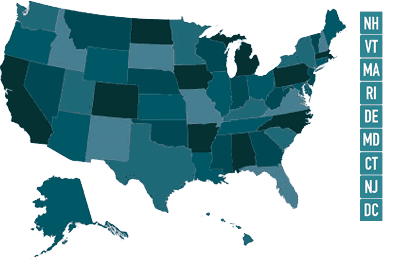
Human Services Education Requirements By State
- Alabama
- Alaska
- Arizona
- Arkansas
- California
- Colorado
- Connecticut
- Delaware
- District of Columbia
- Florida
- Georgia
- Hawaii
- Idaho
- Illinois
- Indiana
- Iowa
- Kansas
- Kentucky
- Louisiana
- Maine
- Maryland
- Massachusetts
- Michigan
- Minnesota
- Mississippi
- Missouri
- Montana
- Nebraska
- Nevada
- New Hampshire
- New Jersey
- New Mexico
- New York
- North Carolina
- North Dakota
- Ohio
- Oklahoma
- Oregon
- Pennsylvania
- Rhode Island
- South Carolina
- South Dakota
- Tennessee
- Texas
- Utah
- Vermont
- Virginia
- Washington
- West Virginia
- Wisconsin
- Wyoming
Frequently Asked Questions
What’s the difference between a human services degree and a social work degree?
A human services degree is broader and more interdisciplinary, preparing graduates for a range of support and coordination roles. A social work degree is specifically designed to meet the educational requirements for social work licensure. If you want to become a licensed clinical social worker or licensed social worker, a social work degree from a CSWE-accredited program is typically required. A general human services degree won’t satisfy those requirements in most states.
Do I need a master’s degree to work in human services?
Not always. Many direct-service positions (case manager, outreach worker, residential counselor, family services coordinator) are accessible with a bachelor’s degree. A master’s becomes necessary when you want clinical licensure (LCSW, LPC, LMHC), independent practice authority, or supervisory and administrative roles. Entry-level positions in human services generally require at a minimum a bachelor’s degree at this point, though some support roles still accept an associate degree.
Does it matter which school I attend for a human services degree?
Accreditation matters more than school prestige. For social work, a degree from a CSWE-accredited program is what most state licensing boards require. For counseling credentials, CACREP accreditation is the standard. A degree from a highly regarded institution won’t substitute for specialty accreditation if your state’s licensing board requires it. Confirm the program’s accreditation status and check your target state’s requirements before enrolling.
Can I complete a human services degree online?
Yes. Fully online programs exist at the associate, bachelor’s, master’s, and doctoral levels, and many are accredited by CSWE, CACREP, or CSHSE. Online coursework generally carries the same licensure eligibility as on-campus programs when the accreditation is equivalent. The in-person component, including field placements and supervised practice hours, still applies regardless of how coursework is delivered.
Key Takeaways
- Degree level and type both matter. A bachelor’s in general human services and a bachelor’s in social work lead to different licensing pathways and career options, even though they’re both four-year degrees.
- Specialty accreditation determines licensure eligibility. CSWE for social work, CACREP for counseling, and CSHSE for general human services. Confirm your program’s accreditation before enrolling.
- Clinical practice requires a master’s. If your goal is independent clinical work, diagnosis, or therapy, a graduate degree in social work or counseling is the threshold requirement in most states.
- Online programs are a legitimate option. Accredited online degrees carry the same licensure eligibility as on-campus equivalents. Field placement hours still happen in person.
- State requirements are the final word. Licensing requirements vary by state. Always check your specific state’s licensing board before choosing a program.
Ready to find the right program? Use our state-by-state guides to look up licensing requirements and explore accredited programs where you plan to practice.