The Counseling Compact: What It Means for Your License and Career

The Counseling Compact allows licensed professional counselors to apply for practice privileges in member states without obtaining a full separate license in each one. The Compact initially launched with Arizona and Minnesota as the first operational states. Because additional states may become operational over time, verify the current live-state list at counselingcompact.gov before relying on any specific list. Counselors must apply for a privilege to practice in each participating state and must hold a qualifying independent license in their home state.
Picture this: you’re a licensed counselor in Texas, and you want to see clients in New Mexico via telehealth. Or you’re relocating from Florida to a new state and don’t want to restart the licensure process from scratch. Until recently, your only option was to apply for a full license in each new state, pay the fees, wait for processing, and navigate each board’s specific requirements. The Counseling Compact changes that equation. This guide explains how it works, who qualifies, which states are in, and why the state you choose for your initial license matters more now than it used to.


What Is the Counseling Compact?
The Counseling Compact is an interstate licensure agreement that allows fully licensed professional counselors to apply for practice privileges in other member states without having to complete the full licensure process in each state. It was developed under the auspices of the National Board for Certified Counselors (NBCC) and is administered by the Counseling Compact Commission, an independent body made up of representatives from each member state.
The model follows the same general framework as the Nurse Licensure Compact, which has been operational for over two decades and now covers most U.S. states. The basic idea is the same in both cases: a professional who holds a full independent license in their home state can apply for a “privilege to practice” in other member states rather than starting the full licensing process over in each one.
An important distinction: a privilege to practice under the Compact is not the same as holding a license in that state. You still apply through the Compact system, meet that state’s eligibility requirements, and receive formal authorization to practice there. What you may avoid is a full separate state license application, though Compact privilege applications still involve fees and state-specific authorization steps. The Compact may streamline multistate authorization, but counselors must still apply for each privilege to practice and comply with the receiving state’s rules.
Which States Are Currently in the Compact?
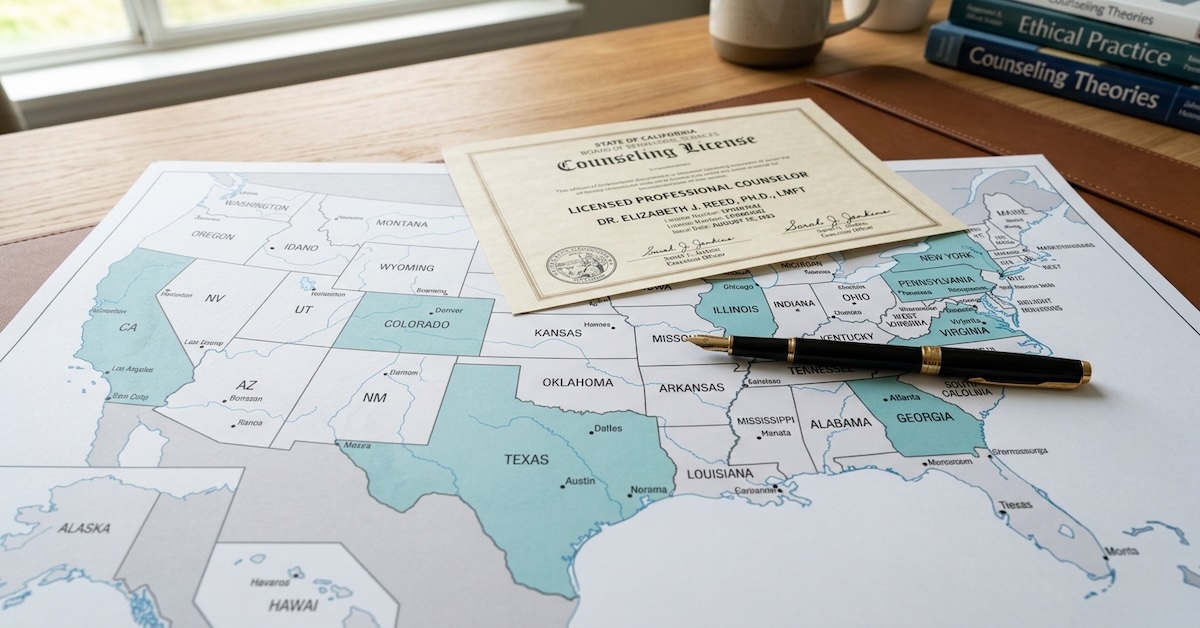
As of publication, Arizona and Minnesota were the first states where the Counseling Compact became operational, meaning counselors licensed in those states could begin using the Compact’s privilege-to-practice system. Dozens of additional states have enacted the necessary legislation and are in various stages of onboarding and implementation. The operational status is changing, and this should be confirmed on counselingcompact.gov.
Because membership is expanding on an ongoing basis, any static list in an article like this one will be outdated faster than it can be updated. The most reliable source for the current member state map is the official Counseling Compact website, which maintains a live map showing operational states, states that have enacted legislation, and states with pending legislation. Check there before making any licensing decisions based on Compact membership.
Many states have enacted Compact legislation, but implementation timelines vary by state. Additional states may join or become operational over time, but specific timelines remain uncertain. Because operational status changes, always check the official Counseling Compact website for the current picture before making licensing decisions.
How the Counseling Compact Works
The mechanics of the Compact center on two concepts: your home state and your privilege to practice. Here’s how the process flows from initial licensure to multistate practice.
Your home state is the state where you hold your primary independent counseling license and where you live. This is the foundation of your eligibility for the Compact. You must maintain a valid, active, unencumbered license in your home state to participate in the Compact. If your home state license lapses or becomes restricted, your privileges in other Compact states are affected as well.
Applying for a privilege to practice is the step you take when you want to see clients in another Compact member state. You apply through the Compact’s centralized system rather than directly to each state board. The process involves verifying your home state license, confirming you meet the receiving state’s eligibility requirements, paying the applicable fee, and receiving formal authorization for that state. Each privilege to practice is state-specific. Wanting to practice in three additional Compact states means applying for three separate privileges.
Once authorized, you’re subject to the laws and rules of the state where the client is located for that practice, not just the laws of your home state. This matters for mandatory reporting requirements, scope-of-practice limitations, and telehealth-specific regulations, which vary by state even within the Compact.
| Step | What It Involves | Who Handles It |
|---|---|---|
| Hold a qualifying home state license | Full independent LPC/LMHC/LCPC/LPCC or equivalent in your state of residence | Your home state licensing board |
| Confirm home state is a Compact member | Check counselingcompact.gov for the current operational status | Counseling Compact Commission |
| Confirm the target state is a Compact member | Verify that the state where you want to practice is operational, not just enacted. | Counseling Compact Commission |
| Apply for the privilege to practice | Submit an application through the Compact system, pay the fee, and meet the receiving state requirements. | Counseling Compact Commission |
| Receive authorization | Formal privilege issued for that specific state | Compact Commission / receiving state board |
| Practice under the receiving state rules | Follow laws of the state where the client is located, including mandatory reporting and scope rules. | Receiving the state board |
Who Qualifies for the Counseling Compact?
Not every counselor automatically qualifies to use the Compact. There are specific eligibility requirements tied to your license type, your disciplinary history, and your home state’s participation. The core requirements, as established by the Compact legislation, are as follows:
| Eligibility Requirement | Details |
|---|---|
| Independent counseling license | Must hold a full, unrestricted independent counseling license in your home state (LPC, LMHC, LCPC, LPCC, or equivalent). Provisional, associate, or supervised licenses do not qualify. |
| Home state residency | Your home state must be the state where you primarily reside. You cannot designate a Compact member state as your home state if you live elsewhere. |
| Home state is a Compact member. | Your home state must be operational in the Compact, not just pending or enacted. |
| Clean disciplinary record | No current license investigations, restrictions, or disciplinary actions in any state. Past disciplinary history may affect eligibility depending on the nature of the action. |
| No criminal history disqualifiers | Certain criminal convictions may disqualify a counselor from participating in the Compact. Requirements vary and are reviewed through the application process. |
| Active, unencumbered license | Your home state license must be current and in good standing. Lapsed or restricted licenses suspend Compact privileges. |
The eligibility requirements are worth reading carefully before you build practice plans around the Compact. A counselor who holds an LPC-Associate (a supervised, pre-licensure credential in states like Texas) does not qualify. A counselor with a past disciplinary action on their record may face additional scrutiny. The Compact is designed for fully independent, clean-record practitioners.
Why Your Initial Licensure State Matters More Now
Before the Compact, where you got licensed mainly affected which state you practiced in, and how long the reciprocity process would take if you moved. As the Compact expands, the state you choose for initial licensure has a new variable: whether that state is a Compact member.
A counselor who earns their post-degree supervised hours and sits for their licensure exam in Arizona can, once licensed, apply for practice privileges in other Compact member states through the streamlined process. A counselor who completes the same process in a non-member state gets licensed and can practice there — but has no Compact access until their home state joins, or until they relocate and re-establish their primary license in a member state.
This matters most for three groups of counselors:
Telehealth practitioners. Compact membership can be highly useful for counselors building a telehealth practice across state lines. Without it, you’re applying for full licensure or other lawful authorization in every state where your clients live. The Compact reduces that burden within the member state network, though counselors may still need traditional licensure in non-Compact states.
Military spouses and mobile families. Counselors in military families face repeated state-to-state relocations, often on short timelines. The Compact was designed in part with this population in mind. A counselor licensed in an operational Compact home state may have more options for multistate practice continuity. However, relocation can require updating home-state status and meeting the new state’s licensing rules.
New graduates are choosing where to complete supervised hours. If you’re still in the post-degree supervised hours phase, you haven’t yet committed to a home state license. Choosing to complete your hours and pursue initial licensure in a Compact member state rather than a non-member state gives you Compact access the moment you’re fully licensed. It’s worth factoring into your program placement and career planning decisions.
For a full breakdown of what licensure looks like in specific Compact states, the counseling licensure guide covers education requirements, supervised hour totals, and exam requirements state by state. You can also explore the differences between the LPC and LMHC credentials if you’re navigating naming variations across states.
The Counseling Compact and Telehealth
Telehealth has significantly changed the practical geography of counseling practice. A counselor sitting in their home office can serve clients in a dozen states — if they’re licensed or otherwise lawfully authorized to practice in each of those states. Before the Compact, counselors in many cases needed a full license or other lawful authorization in each state where clients were located. For most, that meant limiting telehealth practice to their home state or a small number of adjacent states where they’d gone through individual reciprocity processes.
The Compact changes this by replacing full licensure applications with privilege-to-practice applications. For a telehealth-focused counselor in a Compact member state, reaching clients in multiple other Compact states becomes a manageable administrative process rather than a multi-year licensing project.
A critical point that often gets missed: the state where your client is physically located during the session determines which state’s laws govern that session. This isn’t just a technicality. Mandatory reporting thresholds, duty-to-warn requirements, and scope-of-practice limitations vary by state. A counselor providing telehealth services to clients in five different Compact states needs to be familiar with the specific rules of all five states, not just their home state. The Compact authorizes the practice. It doesn’t standardize practice rules across states.
What the Counseling Compact Does Not Cover
The Compact applies specifically to counselors holding the LPC, LMHC, LCPC, LPCC, or equivalent independent counseling license. It does not extend to all mental health professionals, and understanding what’s excluded prevents some common planning mistakes.
The Counseling Compact does not cover licensed Marriage and Family Therapists (LMFTs). The LMFT is a distinct credential from the LPC/LMHC family, governed by different state boards and a different national body. LMFTs should check their state licensing board or professional association for current portability and reciprocity options.
Licensed Clinical Social Workers (LCSWs) are also not covered. Social work has a separate Social Work Licensure Compact framework, but counselors should verify whether privileges are currently available in their state before relying on it for practice planning. Counselors who hold both an LPC and an LCSW may have options under both compact frameworks for their respective credentials, but the Counseling Compact alone does not cover the LCSW.
Substance abuse counselors holding paraprofessional credentials (CADC, LADC, and similar) are not covered. These credentials operate under separate state certification systems and are not part of the Counseling Compact framework.
Provisionally licensed or supervised counselors who have not yet earned full independent licensure are not eligible, regardless of how close they are to completing their supervised hours.
School counselors holding a school counselor certification or endorsement, rather than an independent clinical counseling license, are not covered by the Compact.
If you’re a licensed clinical social worker exploring interstate practice options, the LCSW vs. LPC comparison breaks down how these credentials differ in scope and portability. For counselors still completing supervised hours and exploring program options, our guide to affordable master’s in counseling programs by state can help with early planning decisions that factor in Compact membership.
Frequently Asked Questions
Does the Counseling Compact replace my state license?
No. The Compact does not replace your home state license. It allows you to apply for a privilege to practice in other member states on top of your existing home state license. You must maintain an active, unencumbered home state license at all times to keep your Compact privileges active in other states. If your home state license lapses, your privileges in other Compact states are suspended.
Can I use the Counseling Compact if I’m still completing supervised hours?
No. The Compact is available only to counselors who hold a full, independent, unencumbered counseling license in their home state. Provisional licenses, associate licenses, and pre-licensure supervised credentials do not qualify. The strategic consideration for counselors still in supervised hours is to complete the process and pursue initial licensure in a Compact member state, which gives you Compact access the moment you’re fully licensed.
If I move to a new state, does my Compact privilege follow me?
When you move, your home state changes. Under the Compact, you’re required to notify the Compact Commission of a change in primary residence. You’ll need to establish licensure in your new home state and designate it as your new home state under the Compact. Privileges you held in your previous home state may need to be re-established in your new state. The Compact is designed to make this transition smoother than full re-licensure from scratch, but it does require administrative steps when you relocate.
Does the Counseling Compact cover telehealth sessions with clients in non-Compact states?
No. The Compact only applies to practice within member states. If a client is located in a state that has not joined the Compact, you still need to hold a full license in that state to see them legally. For counselors building telehealth practices across multiple states, the Compact significantly reduces the licensing burden within the member-state network. Still, it doesn’t eliminate the need for traditional licensure in non-member states.
Key Takeaways
- The Compact streamlines multistate practice; it doesn’t eliminate it. Counselors still apply for a privilege to practice in each participating state. What they’re skipping is the full state licensure application, fees, and waiting period.
- Only fully independent licenses qualify. LPC, LMHC, LCPC, LPCC, and equivalent credentials are covered. Provisional licenses, supervised credentials, LMFTs, LCSWs, and substance abuse certifications are not.
- Your home state must be a member of the Compact. Enacted legislation is not the same as operational. Check counselingcompact.gov for the current status before making licensing decisions based on Compact access.
- Initial licensure state now has a strategic dimension. Counselors still completing supervised hours should factor Compact membership into their decision about where to pursue initial licensure, particularly if they anticipate telehealth or multistate practice.
- The state where your client sits governs that session. The Compact authorizes practice across states but doesn’t standardize the rules. Mandatory reporting, scope, and telehealth regulations vary by state and remain your responsibility to know.
- The Compact is expanding. Because membership is growing, any list of member states in an article quickly becomes outdated. Always verify current status at the official Counseling Compact website before making practice or licensing decisions.
Planning your counseling career around the Compact? Start by getting licensed in the right state. Explore accredited programs and state-specific licensure requirements to map out your path.

Licensure requirements and Counseling Compact membership status vary by state and change regularly. Always verify current requirements with your state licensing board and confirm Compact operational status at counselingcompact.gov before making licensing or practice decisions.