LCSW vs. MSW: What’s the Difference and Which Do You Need?
An MSW (Master of Social Work) is a graduate degree. An LCSW (Licensed Clinical Social Worker) is a state-issued license. Every LCSW holds an MSW, but not every MSW becomes an LCSW. The license requires additional supervised clinical hours and a passing score on the ASWB Clinical Exam. If your goal is to provide psychotherapy independently, you’ll need both.
Social work credentials can feel like alphabet soup, and the LCSW versus MSW question trips up many people early in their career planning. They sound like comparable options, but they aren’t quite parallel. One is a degree you earn. The other is a license you qualify for after that degree, and after two or more years of additional supervised work.
Here’s how to think it through clearly and figure out which path makes sense for what you want to do.


What is an MSW Degree?
The Costs of MSW Degree Programs
When To Consider an MSW in Social Work
What is an LCSW?
LCSW vs. MSW: Side-by-Side
What Can You Do With an MSW Degree Without an LCSW?
Which Path Is Right for You?
Salary Differences for LCSW vs. MSW
Organizations That Help Both LCSWs and MSWs Succeed
What is an MSW Degree?
A Master of Social Work is a two-year graduate degree that provides intensive preparation for advanced practice across a wide range of social services roles. The curriculum covers human behavior, clinical treatment, social policy, research methods, and community advocacy. For anyone planning to work at the clinical level in social work, the MSW isn’t optional. It’s the minimum entry point.
For an MSW to count toward LCSW licensure, it has to come from a program accredited by the Council on Social Work Education (CSWE).
More than 300 MSW degree programs in the United States meet the strict standards of the CSWE Commission on Accreditation.
An MSW also puts you on the path to the terminal degrees in social work: the Doctor of Philosophy in Social Work (Ph.D.) or Doctor of Social Work (DSW).
Concentration areas vary by school, but many programs offer specializations in child and family social work, gerontological social work, school social work, social justice and advocacy, and community organizing. Getting into an MSW program requires a bachelor’s degree first. The Bachelor of Social Work (BSW) is the most natural entry point, but students with bachelor’s degrees in psychology, sociology, nursing, or counseling are regularly admitted.
The Process of Earning an MSW Degree
Two-year MSW programs are typically split into a foundation year and a concentration year. The foundation year covers core social work concepts: behavioral psychology, basic research methods, both clinical and macro social work practices, and the structure and policy of social services. The second year allows for specialization, though a generalist track is always available. CSWE requires that clinical social work be part of every accredited program’s core curriculum, so you’ll get clinical training regardless of the path you choose.
A big part of the MSW’s value comes from required hands-on fieldwork through practicum or internship placements. These put you out in the real world, working alongside practicing social workers in live settings. You get direct experience working with people in need and learn the real mechanics of helping them get the help they need.
The Role of The Council on Social Work Education in MSW Degree Programs
CSWE, the Council on Social Work Education, plays a significant role in shaping what the MSW looks like today.
Founded in 1952, CSWE includes members from academia, social services agencies, and independent practitioners. That gives the group a broad perspective on the real-world demands on social workers and the input it needs to inform a useful curriculum at both the bachelor’s and master’s levels.
Although formal social work education has been around since at least the late 1800s, accreditation didn’t appear until the 1930s through the American Association of Schools of Social Work. CSWE traces its roots back to that and competing organizations.
The organization has always focused on establishing professional standards for practicing social workers. Today, their Commission on Accreditation sets out the Educational Policy and Accreditation Standards that define the 9 core competencies in social work that every established MSW program in the country teaches.
Social work agencies and clients know that MSW social workers have all the right theoretical preparation and practical skills to get the job done in a complicated and vital field.
The Costs of MSW Degree Programs
Those two years of expert instruction come with a substantial price tag.
The total cost of a master’s degree often ranges from $30,000 to $60,000 or more depending on the institution, according to NCES estimates. That’s before accounting for the cost of the bachelor’s degree you had to earn first.
Most people on their way to an MSW don’t have that kind of money sitting around, particularly after the cost of a bachelor’s degree. A majority of social work graduates carry student loan debt, often in the $30,000 to $50,000 range, according to CSWE and related surveys. That’s close to what many social workers earn in their first full year of employment. It’s worth looking hard for scholarship support before committing to loans.
Federal Pell Grants are available based on financial need. Field-specific scholarship options include:
- The National Association of Black Social Workers offers scholarships from $1,000 to $1,500 to Black students pursuing social work careers who demonstrate community service and meet GPA requirements.
- The Council on Social Work Education offers scholarships and fellowships ranging from $500 to $10,000 for minority students in mental health or substance abuse services, or social work students with a demonstrated commitment to equity and social justice.
- The Melanie Foundation offers a $2,500 scholarship to graduate students planning to enter the mental health field, including those pursuing clinical social work.
Loan Forgiveness Programs Can Make an MSW in Social Work More Affordable
Several loan-forgiveness programs can meaningfully reduce the cost of an MSW for graduates entering public service or healthcare. Social work sits right at that intersection. The federal Public Service Loan Forgiveness program can write off the outstanding balance of any federal student loans if you’re employed full-time by a government or nonprofit organization, are in good standing on your payments, and have made at least 120 qualifying payments.
The National Health Service Corps loan repayment program, run by the Health Resources and Services Administration (HRSA), is designed for health care workers serving in high-need communities. For social workers, that means applying under the Substance Use Disorder Workforce eligibility area or the Rural Community area of the program.
When To Consider an MSW in Social Work

The MSW is generally considered the entry-level credential for clinical social work, but it’s also expensive. Depending on your career direction, you may not need one. Many social work positions are accessible with only a bachelor’s degree, including administrative and healthcare social services roles. So, when do you need an MSW? The clearest answer is when you want to practice clinically.
What Is Clinical Practice in Social Work?
Clinical social work practice involves assessing, diagnosing, and treating mental illness and other emotional and behavioral issues. It’s an applied therapy, similar to what’s practiced by licensed counselors and psychologists. Clinical skills include hands-on, supervised therapy work with clients and a deeper grounding in human development and abnormal psychology. The tools of clinical practice include Cognitive Behavioral Therapy, Supportive Psychotherapy, Psychosocial Assessment, and Biopsychosocial Therapy.
In every state, you will need an MSW to work at the clinical level in social work.
The skills that come with an MSW are in demand well beyond traditional social work settings. Communications, cultural competency, advocacy, community organizing, and sociological research transfer into jobs in community health services, economic equality, and social policy. Some MSW graduates go into politics. Senators Kyrsten Sinema and Debbie Stabenow were both master’s-qualified social workers before being elected to office.
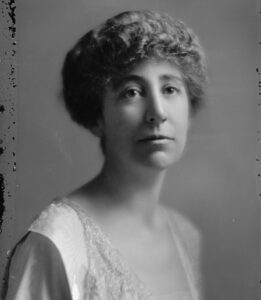 Jeanette Rankin was the first woman elected to Congress in the United States and was an accomplished social worker.
An MSW degree doesn’t magically qualify you to work in politics, but it sure can help. Senators Kyrsten Sinema and Debbie Stabenow were both master’s-qualified social workers before being elected to office. Sinema even taught in the field at the ASU School of Social Work.
When you think about it, political organizing leans on a lot of the same skills you’ll learn in an MSW program. Community organizing, activism, communications, and a strong sense of social justice are all great assets for someone with political ambitions.
It also has a long history. Back before there even was such a thing as an MSW degree, Montana’s Jeanette Rankin became the first woman ever elected to Congress in 1916, after a career fighting for social justice. She continued that fight in the halls of power up to the 1940s. Her leadership resulted in legislation to improve working conditions for miners and federal employees, and she championed social welfare and universal suffrage.
What is an LCSW?
The Licensed Clinical Social Worker credential is a state-issued license that authorizes social workers to deliver clinical psychotherapy and other counseling treatments. Although most states use the LCSW title, equivalent licenses in other states go by different names: LGSW (Licensed Graduate Social Worker), LICSW (Licensed Independent Clinical Social Worker), LMSW (Licensed Master Social Worker), LISW (Licensed Independent Social Worker), and LSCSW (Licensed Specialist Clinical Social Worker).
LCSWs are authorized to provide both general and clinical social work services, including individual and group counseling and psychotherapy for depression, addiction, family and couples counseling, and juvenile and school counseling.
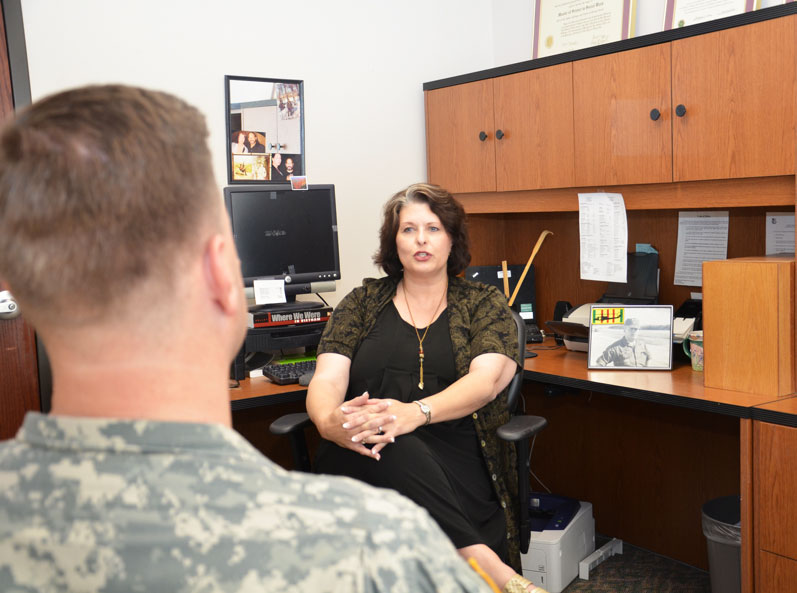
LCSWs have a wide array of specialties they can practice, including working with active-duty military personnel or veterans – (U.S. Army photo by Patricia Deal, CRDAMC Public Affairs)
Rigorous Testing and Client Contact Hours Are Required to Earn an LCSW
After earning an MSW, anyone pursuing an LCSW must also complete supervised clinical hours (typically around 3,000, though exact requirements vary by state). That’s a minimum of two years of full-time supervised practice in a clinical setting before you can even apply for the license. Some states require an intermediate license while you’re building up those hours.
Earning the LCSW always requires passing the ASWB Clinical Exam, which consists of 170 multiple-choice questions and has an exam fee of approximately $260 (subject to change). Most states also require a state-specific examination on laws and ethics, a criminal background check, and may require references or other qualifications.
LCSW vs. MSW: Side-by-Side
Here’s how the two credentials compare on the factors that matter most for career planning:
| Factor | MSW Degree | LCSW License |
|---|---|---|
| Type | Graduate degree | State-issued license |
| Time to earn | 2 years (or 1 year advanced standing) | 2 to 3 additional years after MSW |
| Requirements | Bachelor’s degree, CSWE-accredited program | MSW + ~3,000 supervised hours (varies by state) + ASWB Clinical Exam |
| Can you diagnose mental illness? | No | Yes |
| Can provide independent therapy? | No | Yes |
| Private practice eligible? | No | Yes |
| Works in non-clinical roles? | Yes | Yes |
Where Does the LMSW Fit In?
In some states, there’s an intermediate step between earning an MSW and obtaining an LCSW: the Licensed Master Social Worker (LMSW). Not every state offers this credential, and those that do define it differently. In some cases, it’s a standalone license for macro or direct social work. In others, it’s a pre-license that allows you to provide clinical services under supervision while you build up hours toward the LCSW. The LMSW must pass the ASWB Master’s or Advanced Generalist exam, rather than the Clinical exam. Check your state’s licensing board to see whether an LMSW is required as an intermediate step where you plan to practice.
What Can You Do With an MSW Degree Without an LCSW?
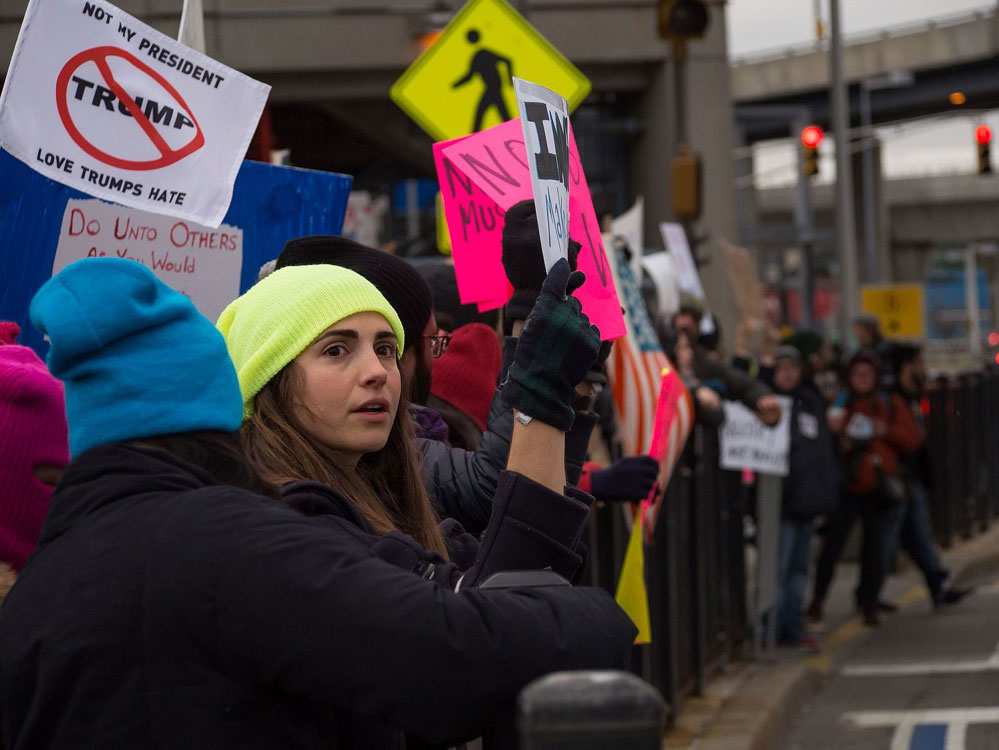
Protestors at JFK International Airport, organized in part by social workers, object to an executive order banning Muslims from traveling to the United States – Rhododendrites, CC BY-SA 4.0 <https://creativecommons.org/licenses/by-sa/4.0>, via Wikimedia Commons.
Plenty of rewarding, high-impact work is available to MSWs without requiring clinical licensure. A few examples:
- Political Lobbyist – Social workers aren’t shy about taking their values to the seat of power. A lobbyist for nonprofit social service agencies brings more weight to the job with an MSW behind them.
- Grassroots Organizer – Community organization is a powerful tool in social work. From suffragette marches to airport sit-ins, grassroots organizers have changed history. You don’t need a license for that, but an MSW is a real advantage.
- Strategist – Putting together plans of action when funding is scarce is exactly the kind of analytical work MSW training prepares you for.
- Social Services Entrepreneur – New technology and new ideas are as effective in building social justice as they are in building social networks. Social entrepreneurs develop new models to serve the ideals of human services work.
Some of the Biggest Impacts Come From Simple Solutions
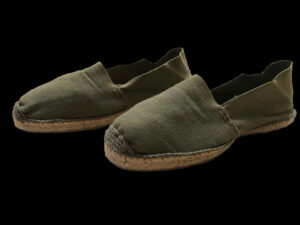
Argentina’s traditional Alpargata shoes are pretty basic: rope-soled, canvas-topped, low-cut slip-ons seen on feet all over South America. Blake Mycoskie noticed on a trip to Argentina in 2006 that many kids were still running around barefoot.
He ran into a volunteer whose organization was struggling to get donations to buy shoes for those children. She showed him the infections, sores, and social stigma that went along with going without shoes. Mycoskie returned to the United States with a new idea: build a company that would market the Alpargata to Americans with an innovative twist. For every pair purchased, the company would donate a pair to a child.
He was going to call it “Tomorrow’s Shoes,” but TOMS just seemed to work better.
By 2011, the company had donated its one millionth pair. By 2018, it was donating to more than 70 countries, having provided 60 million pairs and branched out into clean water and other charities. That’s what social entrepreneurship can achieve.
MSW skills also transfer well into private-sector roles, including community outreach, marketing, human resources, program development and management, and case management across insurance, managed care, job programs, and criminal justice rehabilitation.
Which Path Is Right for You?
If you want to provide therapy independently, diagnose and treat mental health conditions, or run a private practice, you’ll need an LCSW. The MSW is the required first step, but it’s not the finish line.
If you’re drawn to policy work, community organizing, case management, administration, or advocacy, an MSW without an LCSW can take you far. Many of the most impactful roles in human services don’t require clinical licensure.
A practical question to ask yourself: Do you want to work directly with individual clients in a therapeutic capacity, or do you want to work on the systems and structures that affect those clients? Clinical practice points toward the LCSW. Everything else can often be done with an MSW alone.
Salary Differences for LCSW vs. MSW
It’s impossible to isolate the salary difference between an LCSW and a plain MSW, because every LCSW already holds an MSW. But BLS data does give you a useful picture of what different social work specializations earn, and clinical work tends to pay more.
According to the Bureau of Labor Statistics, the median annual salary for all social workers was $61,330 as of May 2024. Here’s how the specializations compare:
| Social Work Specialization | Median Annual Salary | 10th Percentile | 90th Percentile |
|---|---|---|---|
| All Social Workers | $61,330 | $41,580 | $99,500 |
| Healthcare Social Workers | $68,090 | $45,030 | $100,870 |
| Mental Health and Substance Abuse Social Workers | $60,060 | $39,620 | $104,130 |
| Child, Family, and School Social Workers | $58,570 | $40,580 | $94,030 |
| Social Workers, All Other | $69,480 | $44,530 | $112,740 |
A National Association of Social Workers survey found that all master’s-qualified social workers earned an average of over $13,000 more than those who only held a bachelor’s degree. For a full breakdown by specialization and state, see our detailed MSW salary guide. The LCSW drives wages further, since it opens clinical and independent practice positions that aren’t available to MSW holders without licensure.
The job market is strong across both tracks. According to BLS projections, mental health and substance abuse social workers are expected to grow 10.6 percent between 2022 and 2032, with roughly 9,500 average annual openings. Healthcare social work is projected to grow 9.6 percent, with about 18,700 openings per year. Child, family, and school social workers will see about 5.3 percent growth, with an average annual opening of 29,500.
Organizations That Help Both LCSWs and MSWs Succeed
Whether you’re pursuing both credentials or planning to stop at the MSW, you’re part of the same professional community. These organizations support social workers at every level:
- National Association of Social Workers – The largest organization of social workers in the world, carrying significant weight in setting professional standards, social policy, and workforce development.
- National Association of Black Social Workers – A major advocacy group for multiculturalism and cultural competency in social services, representing a significant and growing segment of the social work workforce.
- School Social Work Association of America – Supports school social workers who deal with some of the most vulnerable populations in the country, and advocates for more compassionate approaches to youth services.
- North American Association of Christians in Social Work – Works to uphold faith-rooted traditions in social work and advocate for social workers of faith.
- Clinical Social Work Association – Focuses on supporting LCSWs and other clinical social work specialists, and advocates for clinical social work interests at the state and federal levels.
- International Federation of Social Workers – Connects social workers across nations and coordinates international efforts on issues like refugees and climate justice.
Frequently Asked Questions
Do you need an MSW to become an LCSW?
Yes. An MSW from a CSWE-accredited program is a required first step for LCSW licensure in every state. No state will issue an LCSW to someone without a master’s degree in social work. After earning the MSW, you’ll still need to complete supervised clinical hours (typically around 3,000, though requirements vary by state) and pass the ASWB Clinical Exam before you can apply for the license.
Can an MSW provide therapy without an LCSW?
Generally, no, not independently. An MSW graduate who hasn’t yet earned an LCSW can work in clinical settings under the supervision of a licensed clinician, which is actually a required part of the path to licensure. But providing therapy independently, running a private practice, or diagnosing mental health conditions requires an LCSW or equivalent state license.
How long does it take to go from MSW to LCSW?
Plan for two to three years after earning your MSW. Most states require around 3,000 hours of post-graduate supervised clinical work, though exact requirements vary, translating to roughly two years of full-time clinical employment in most cases. Add in exam prep and the application process, and three years is a realistic estimate for most people. Some states also require an intermediate license before you can work toward LCSW licensure.
What’s the difference between an LCSW and an LMSW?
The LMSW (Licensed Master Social Worker) is an intermediate license available in some states. In some states,s it’s a standalone credential for non-clinical work. In others, it’s a step on the path to LCSW, allowing supervised clinical practice while you accumulate the hours needed for the higher license. The LCSW requires more supervised experience and a more advanced clinical exam. Not every state uses the LMSW designation, so check your state’s licensing board for specifics.
Is an LCSW worth the extra time and cost?
Suppose your goal is to provide therapy independently or work in clinical mental health settings, yes. The LCSW opens doors that an MSW alone won’t, including private practice, independent clinical supervision, and a broader range of clinical employment options. If your goals are in policy, community organizing, case management, or administration, the additional years for an LCSW may not be necessary for the work you want to do. You may also want to compare the LCSW to other clinical counseling licenses, like the LPC and LMHC, before deciding on a path.
Key Takeaways
- MSW is the degree, LCSW is the license – They’re not equivalent options to choose between. You need an MSW first, and then you can pursue an LCSW on top of it.
- Clinical practice requires both – If you want to diagnose and treat mental health conditions or run a private practice independently, you’ll need the LCSW. An MSW alone won’t get you there.
- An MSW opens plenty of doors without licensure – Policy work, community organizing, case management, administration, and many private sector roles value the MSW degree without requiring clinical licensure.
- The LCSW takes 2 to 3 more years. After your MSW, count on at least 3,000 supervised clinical hours and a passing score on the ASWB Clinical Exam before you can qualify.
- Salaries are strong at both levels – BLS data shows median social worker salaries ranging from $58,570 to $69,480 depending on specialization, with the LCSW credential typically enabling access to higher-paying clinical roles.
Ready to start mapping out your path? Whether you’re aiming for clinical licensure or a non-clinical MSW career, understanding your state’s requirements is the right first step.
2024 US Bureau of Labor Statistics salary and employment figures for Social Workers, Social and Human Services Assistants, Social and Community Service Managers, and Substance Abuse, Behavioral Disorder, and Mental Health Counselors, reflect state and national data, not school-specific information. Conditions in your area may vary. Data accessed April 2026.